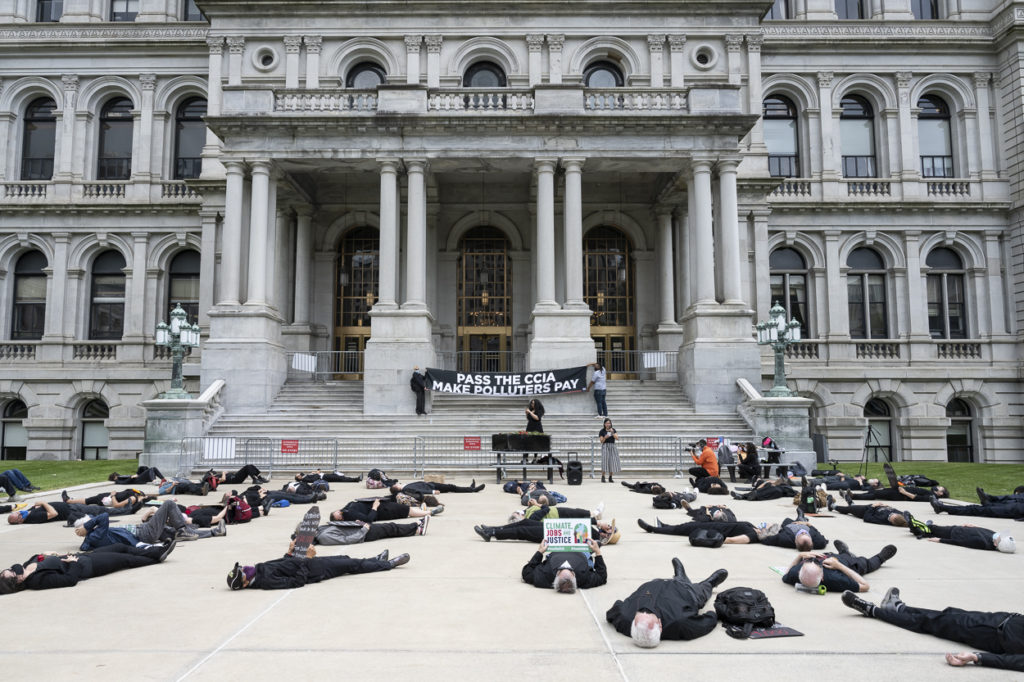
The Fate of the CCIA

The fossil fuel industry in New York State faced its most determined threats in the past two years and prevailed. Although a supermajority of Democrats in the State senate and the Assembly would appear to be insurmountable, the fossil fuel industry used its lobby arm and judicious donations to Democratic coffers to defeat legislation that would have aggressively torn into their profit models. These models, based on the continued use and expansion of fossil fuels in the state, will remain untouched by the legislature this year.

The legislature closed its session without comment on any of the climate bills that moved into committee but failed to come to the floor for a vote. The most ambitious of the climate bills, the Climate and Community Investment Act, often referred to by its initials, the CCIA, was the second half of the Climate Leadership and Community Protection Act that passed in 2019 with far reaching mandates but without funding mechanisms. The CCIA was proposed as a “make polluters pay” tax bill, placing the burden of switching from fossil fuels to clean renewable energy – and cleaning up the pollution left behind – upon the large-scale carbon producers in the state The mechanism was a $55 tax on every ton of carbon dioxide.

The CCIA was proposed by the largest coalition of environmental organizations in the state’s history. Over 280 organizations joined the NY Renews coalition to fight for the CCIA. The coalition included environmental organizations, social justice organizations, local and regional groups, houses of worship, labor unions, and private businesses. They organized protests, rallies, education events, and an aggressive lobbying schedule across the state. The coalition far exceeded its own goals in reaching out to legislators and shepherding the bill through the legislative process. At the of the session, legislative leaders were silent on the fate of the bill.

Two other climate bills with organized backing behind them also failed to come to a vote. The first, the Clean Futures Act, would have prohibited building new fossil fuel infrastructure in New York. The bill would have shut down three projects in Queens, Brooklyn, and Newburgh, located on the Hudson River. None of the projects are necessary for electrical capacity. The consequence of the bill’s failure is a green light for new natural gas projects.

The Build Public Renewables Act was the third bill to disappear in legislative silence. The bill would have required the New York power authority to provide only renewable energy and power to its customers, namely state-owned and municipal properties. The bill was passed into committee and died there.

So thoroughgoing was the fossil fuel industry and the New York Business Council in squelching all three bills, that the legislators are not speaking to any of the proponents of the bill. Members of the NY Renews coalition had been asking for weeks for clarification of hurdles and challenges to the CCIA bill. They did not receive answers. The continued silence of the legislators is a thunderous conclusion of a session that began with raised expectations of success.

How Much Did Hurricane Sandy Cost?

Not only was Sandy the largest storm ever recorded, its continuing costs continue to accumulate in eyepopping numbers. Hurricane Sandy is the best/worst example of climate change as a threat multiplier in New York State.

Read the article in New Scientist here.

Climate Change Legislation in a Nutshell

Six Arenas

Sitting in front of a computer screen in the middle of another Zoom conference on climate change, the exuberance of the presenters is consistently tested by the scope of the legislative endeavors that must pass. The issue is not the cliché that “no bill is perfect,” which is true. Rather, climate change is a threat multiplier across every human activity and endeavor, and its footprint is global. A Green New Deal bill will accomplish much in the coming decade, but no one bill can anticipate nor address all the issues created by human output in the last one hundred years.

At present, we are on a baseline trajectory to raise the median temperature of the earth by 2100 +3.5oC (6.4oF). The baseline is the output of carbon we are experiencing today without any change or mitigation.  Today’s baseline is unsustainable, and the result would be a planet with huge swaths of uninhabitable land and ocean by the end of the century. With the proposed legislation, we will continue to produce carbon, pumping the element into the water and into the air, but the goal is to control and reduce the carbon output to a sustainable +1.5oC (2.7oF).

M.I.T.’s Management Sustainability Initiative divides up the carbon reduction puzzle into six arenas:

  1. Energy Supply
  2. Transport
  3. Buildings and Industry
  4. Growth
  5. Land and Industry Emissions
  6. Carbon Removal

Our legislative endeavors need to force changes in each of these six areas. If all the areas are not addressed, even if only one area is ignored, we will be unable to reach our sustainable goal of +1.5oC (2.7oF). Each area requires a firm legislative shove, often more than one. What follows is an outline of what is contained in each arena and what must be done. Each bullet point requires new aggressive legislation.

Energy Supply

The big four carbon producers that must be reduced to as close to zero as possible are:

  • Coal
  • Oil
  • Natural Gas
  • Bioenergy (e.g. wood, wood pellets)

The energy producers that do not produce carbon are called renewables. They must take over as much energy production as possible:

  • Solar
  • Geothermal
  • Wind
  • Nuclear* (*renewable but not clean)

The lever that forces the energy supply to shift from coal/oil/gas to renewables is:

  • Carbon price/Carbon Tax

We may also need a break-through technology that does not emit greenhouse gases. Several have been proposed but none will be available in the foreseeable future. Funding is through research and development.

  • New Zero-Carbon Breakthrough

Transport

All forms of transportation (ships, planes, trucks, cars) must shift to,

  • Energy Efficiency
  • Electrification

Buildings and Industry

All mechanicals in buildings and the processes and machines for manufacturing must make the same shift as transportation.

  • Energy Efficiency
  • Electrification

Growth

Some parts of the world are already experiencing a slowdown in population from an exponential trajectory to a geometric one, although not all populations are decreasing. Economic growth as defined by Gross Domestic Product must also decrease. We need to aim for less people and less stuff, backing away from a growth model for economies.

  • Population
  • Economic Growth

Population tends towards self-regulating when education rates rise in general and when education policies specifically targeting women are implemented. The issues of less manufactured goods are partially addressed in “Right to Repair” laws that create longer-lasting products and the legal ability/capability to repair locally.

Land and Industry Emissions

While energy consumption is tackled above, the pollution generated by industry and agribusiness must all be addressed. Monoculture agribusiness must transform to soil-healthy processes that are not dependent on manufactured fertilizers, herbicides, and insecticides.

  • Deforestation
  • Methane, fertilizers, HTC’s, and PFC’s

Carbon Removal

The only known carbon removal technology available today is replanting what we have destroyed on land and in the ocean. We will need new technology to pull carbon out of the air, either enhancing natural removals or manually sequestering carbon. Such technology does not exist yet.

  • Afforestation
  • Technological Carbon Removal

Putting the Points Together

No one bill will address all these issues. Legislation that redirects agriculture hardly seems like a climate change bill but both monoculture farms and beef ranches are huge contributors to the carbon pollution matrix. Government investments in education lead to smaller households in the next generation, an education bill. Shifting government subsidies from coal, oil, and gas to renewables would address the most significant source of carbon production, which is a straightforward energy bill. One bus can remove sixty cars from the daily commute, which would be funded in a transportation bill.

Some solutions will require international treaties and corporate compliance. We should invest in research and development, which would have a side effect of reducing college costs as the Sputnik program did. Corporations are guilty of the worst carbon pumping crimes and they need to fundamentally change or be forced to change into implementors of solutions.

We must pass legislation that does not include wishful thinking. A breakthrough technology just around the corner, hydrogen-powered cars for example, is a fantasy. The technology solution is not around the corner, which is no surprise because we have not invested much in developing such an invention. New technologies require investment and time; we have given neither.

Final Word

Your head should be spinning. At the least, organizing the bullet points in one place presents a clear direction of what sorts of legislation and regulations we need in the next year. Every bill is battle and we need a lot of bills to become law.

We are asking our legislator allies to cover all these legislative areas when we cannot track them ourselves. Using the M.I.T structure, we can organize progress in each of the six arenas. This tracking helps us help our legislators stay informed and on-track, while keeping ourselves informed as best we can.

We can do this.

Biden “Build Back Better” Plan is out

We’ve added a comparison page for you to evaluate the new Biden Infrastructure Plan. This plan will be the primary initiative for moving the nation to a clean, renewable energy future while addressing past environmental injustices. A consortium of environmental groups proposed “The Thrive Act” earlier this year, which addresses climate change and environmental justice in a scientifically grounded set of proposals. You can now compare a snapshot of both plans in an easy-to-read table on our new page pinned to the menu on the our homepage..

You (You kindhearted soul) Are The Target

The competent magician compels the audience to turn their attention elsewhere while the switch is made, seemingly unseen. Magicians are Old School though, because entire industries have adopted the mechanism of deception as their entire public relations strategy. The tobacco industry got away with it for fifty years and now the fossil fuel industry is well into its fourth decade of deceit. Their latest target is your growing desire to address climate change.

The Exxon-Mobil’s, Shell’s and Koch Brothers know they can no longer suppress or delay your fear of climate change consequences. All forms of communication are beaming video, pictures, and commentary of the rising natural events that are destroying lands, disrupting regions, and leaving swathes of dead creatures, even human beings. The corporations know the entirety of the fossil fuel industry is responsible. They even recognize that most of the world’s population knows of their culpability.

Still, they hope to delay the dismissal and banning of fossil fuels and their byproducts. They have an excellent plan. They are not going to talk about their responsibility, they are going to broadcast your responsibility. They are presenting a marketing plan that declares, “You are the problem, and you are the solution to climate change.”

Yes, you are the problem and all that you need to do is tidy up your little piece personal property. Save the planet by putting in a compost heap. Help your community by consolidating your errands into a minimum number of trips. Dry your laundry on a line in the backyard. Change out lightbulbs. Replace that dirty old furnace with a new, efficient model. Use the Energy Star program and replace all your appliances as they age. Recycle.

Do all these things, the marketing promises, and you will have addressed your personal responsibilities. You are done and you should be proud of yourself for addressing climate change. Sit back and appreciate life.

Each and every step of this pernicious initiative is a lie, a devastating one too. Compared to the gigatons of emissions being pumped into atmosphere, every possible act and deed an individual can do to address their personal responsibilities is negligible. Your actions are a drop of spit off the pier when the freighter is discharging its bilge water in the harbor.

What do you really need to do to address climate change?

  • Hold the fossil fuel industry accountable. This is the action they fear. Bringing attention to their culpability and demanding action against them is what they are paying P.R. firms to help them avoid.
  • Demand loudly and often that your legislators act
  • Elect legislators who support climate change legislation
  • Demand that state agencies and regulatory bodies enforce environmental laws.
  • Go to zoning board meetings
  • Attend public meeting of state and county agencies.
  • Broadcast as loudly as the fossil fuel industry does.

Vote!

The equation is simple. Belief in God and scientific confirmation of climate change coalesce into the imperative that the believer must vote climate change this November. The fact of climate change demands that we vote for candidates willing to address global warming at all levels of government. The local races are just as important as the state and national ones.

What is the most important thing a religious person must do now? Vote.

You feel the imperative to praise God? Vote for God’s creation.

You feel the need to repent to God? Then vote for God’s gifts to humanity.

Do you believe that holy words and the sacred relationship with God are being subverted for selfish gain? Vote.

Feeling helpless? Vote.

Vote with your faith, but vote.