Choosing Your Climate Words Carefully

“Global warming” is an accurate but sometimes misleading term.  The seemingly slight increase in average temperatures at the surface of the earth’s land and oceans that is occurring can produce large changes in flows of air and water currents that lead to “global climate change, “ which is a neutral term for what is already going on world-wide.  “Warming” sounds a little too cozy.  Who among us New Yorkers wouldn’t want to be less chilly after all – unless, of course some of those climate changes include droughts in some places and floods in others.

Words matter, as those of us who write or preach know. We often like to use the newer term “climate instability” or “catastrophic climate change.” The truth of the matter is that changes in ocean currents or the melting of permafrost that leads to large releases of methane, a powerful greenhouse gas, may push us over a tipping point to sudden climate disasters, the timing of which is unpredictable.

A more serious misnomer is the term “fossil fuel,” Calvin DeWitt, Emeritus Professor of environmental studies at the University of Wisconsin-Madison, writes in the September-October issue of Sojourners magazine.  Earth is sustained as a habitable abode by a great longstanding natural system of carbon sequestration, whereby plants through photosynthesis took carbon dioxide from the atmosphere and stored it as peat, coal, natural gas, and petroleum.

If we use the term “fossil carbon” instead of “fossil fuel”, we recognize that, as DeWitt writes, “…carbon is much more than fuel: It’s the backbone of all life, a major atmospheric regulator of Earth’s climate, and a moderator of the acidity of the world’s oceans. Burning Earth’s great system of carbon sequestration is disastrous for the biospheric economy—and therefore for our own.”

If we consciously replace the term “fossil fuel” with “fossil carbon,” we may be more careful in how we treat it.

Book Review: Almost Amish by Nancy Sleeth

Almost Amish CoverThis latest effort by Nancy Sleeth, author of Go Green, Save Green, provides and excellent path to the melding of one’s Christian faith and the stewardship of the world we live in.

Nancy has used the numerous examples of the Amish as a means through which we can simplify our lifestyle and in the process establish and strengthen our connection to God.   While many may view this as a step backward to the past, Nancy has made a great case through the examples of her own life of the numerous benefits to simplification.

Almost Amish provides many points for all of us to ponder on how today’s lifestyles are making us busy, but at a cost of losing our relationships to God, family, friends and community.  The book will make you question what you are truly seeking from life.  The book is very much about establishing covenantal relationships and the placing of God and community above self.

I highly recommend this book to those who not only want to preserve and protect the world we live in, but to those who would weave the elements of their Christian Faith into the life they live.

Thanks to Nancy and her daughter Emma, for enabling me to review this book.

Review by Ed Bennett

Huguenot Church Installs Geothermal Energy System

Huguenot Church in Pelham, New York has taken their commitment to the environment to a new level; they have decided to install a geothermal energy system in their 135-year-old church, taking a major step toward independence from fossil fuels.

Going to geothermal power is a dramatic move, but Elysa Hammond, an elder at Huguenot Church and co-leader of their environmental stewardship initiative, said that this is just the most recent step in years of making changes.

One of the first seeds of “climate awareness” was planted in 2004 when a speaker from New York Interfaith Power & Light spoke at Huguenot, discussing the reasons why people of faith need to care about climate change.  That presentation led to Huguenot’s membership in NYIPL and to their church building’s first energy audit.

Then the congregation showed An Inconvenient Truth to a full house, and brought in other experts on global warming including an environmental economist, a journalist from National Geographic, and a theologian.  Increasingly their congregation began to believe that addressing climate change was “the right thing to do.”

From there, they began taking concrete steps such as switching out incandescent light bulbs for compact florescent ones, placing recycling bins throughout the building, and reducing their use of disposable dishes at social events. When presented with routine maintenance needs or investments in furniture, carpets and flooring, they began to seek out the use of more sustainable materials. With each decision they would ask themselves, “Is this compatible with our mission?”

The geothermal plan began to take shape two years ago when a few things happened that necessitated –and inspired– change. First, another congregation that had been sharing the space and maintenance costs found their own church building and left. Then, Huguenot began to have difficulty with their oil-based heating system, and they decided that it must be replaced.

Huguenot’s minister, who is very committed to the environment, and other leadership decided to hold a retreat to “re-imagine” their building space so that it would support the whole ministry of the church, which includes a pre-school, several youth groups, multiple choirs and other community organizations.

After much discussion at the retreat, they decided that the wisest energy choice, given their long-term commitment to remain in the building and community, would be geothermal. One advantage is that it provides year-round heating and cooling. When they looked at the positive impact this would have on their annual utility bills, “the payback was huge.”

They named their fundraising campaign “Sustainable Huguenot” because geothermal power is not only a renewable source of energy where the planet is concerned, but also investing in geothermal energy would lead to a long-term reduction in energy payments, increasing the financial sustainability of the congregation. It will take at least fifteen years to make their money back, but in the life of this 135-year-old church which plans on being around for another 100 years, fifteen years is an investment that makes sense.

Huguenot’s campaign has been blessed with a wonderfully diverse group of people who are helping to make this dream a reality including church leaders with professional backgrounds in architecture, finance, engineering and environmental science.

Jeff Marcks, who led the capital campaign, mentions that congregations might consider using their own endowments to finance such projects. Huguenot did this, and is paying back into their endowment as contributions for the capital campaign come in.

Marcks says that one thing that helped Huguenot achieve their goal is that the leadership and congregation share a common vision to make the building and its management consistent with their mission as a church. Huguenot is deeply committed to being a good steward of their natural resources. They also know that the money saved on utility bills can be put to use in more positive ways.  Hammond offers these words of encouragement: “It takes time to arrive at a decision like this,” she says, “but looking back I can see how our small steps in environmental education and action have added up. We hope our story will encourage others to consider this path.”


POSITION STATEMENT: 2012 Solar Jobs Bill

Statement: New York Interfaith Power and Light strongly supports the New York Solar Industry Development and Jobs Act of 2012.  The bill will position New York as a renewable energy leader by establishing a sustainable market for solar energy development.  Increasing New York’s reliance on solar energy will provide a hedge against volatile fossil fuel prices, reduce peak demand, improve the quality of the air we breathe, and drive economic development across the state.

The legislation draws from and improves upon successful models in other states, and supports a broad diversity of business models, customer types and technologies in order to ensure market growth in all market sectors.  The bill creates the long-term certainty necessary for solar investment, while continuously driving lower-cost installations.  And since solar creates more jobs per MW than any other power source (on a capacity basis), it’s an excellent driver of local economic development.  Over the course of the program, the proposed policy will create jobs across a wide spectrum of professions, ranging from business managers and salespeople to engineers, installers and electricians.  With an established local market, New York will have the opportunity build a manufacturing base, and play a leadership role in this important energy resource of the future.

Solar is well matched to New York’s power needs, as its highest production comes in the summer when the state needs power the most.  This correlation to system peak means that an investment in solar reduces the need for the most expensive, and often most polluting, electricity generation supply.  In addition, solar energy’s modularity means that it can be sited within congested distribution networks, saving on electric line network upgrades and reducing the need for new transmission.

Jumpstarting the solar industry in New York will have a gross impact of less than 1 percent to total statewide spending on electricity—and that’s not counting the benefits of transitioning from volatile, polluting fossil fuels to fuel-free renewable resources.  It’s a small price to pay to start saving with the sun.

This bill will create new jobs, increase energy independence, reduce global warming pollution, and improve electricity system reliability.  It’s what New York needs, and we strongly urge its immediate passage.

NYIPL: New York Interfaith Power & Light is a faith-based non-profit organization that serves the state of New York.  Our mission is to support congregations of all faiths in their actions to curb global warming and protect the sacredness of the earth. We currently have 80 member congregations, and regularly communicate with 2000 people via our email list.

We are part of a national network of congregations of all faiths concerned about the effects of global warming and power plant pollution.

Contact: Janna Stieg Watkins, NYIPL Executive Director (315) 256-0078

POSITION STATEMENT: Hydraulic Fracturing

July, 2010

Statement: New York Interfaith Power and Light urges the EPA to use the Precautionary Principle in a scientifically sound comprehensive study of the process and impacts of hydrofracking.

NYIPL has serious concerns about the safety of hydraulic fracturing (“fracking”).  Each drill injects 50,000 to eight million gallons of water mixed with sand and chemical additives into a geologic formation below the surface of the earth. The drilling industry has resisted revealing exactly what chemicals are used in the fluid. The high pressure creates fracturing in the rock which then releases the natural gas into the well. According to Environmental Advocates of New York (eany.org), more than 1,400 cases of water contamination related to drilling have occurred across the country. Recently the University of Buffalo has discovered that the process may cause uranium that is naturally trapped within Marcellus shale to be released.

NYIPL questions the use of precious resources to mine yet another fossil fuel, especially one with such potential dangers, and urges that no expansion of this practice should occur until such concerns are resolved.

NYIPL: New York Interfaith Power & Light is a faith-based non-profit organization that serves the state of New York.  Our mission is to support congregations of all faiths in their actions to curb global warming and protect the sacredness of the earth. We currently have 79 member congregations, and regularly communicate with 900 people via our email list.

We are part of a national network of congregations of all faiths concerned about the effects of global warming and power plant pollution.

Summary:  The precautionary principle states that if a practice, such as hydraulic fracturing, has a suspected risk of causing harm to the public or to the environment, that the burden of proof that it is not harmful falls on those promoting the practice. In this case that would be those entities promoting hydraulic fracturing.

There are substantial potential risks to hydraulic fracturing. The concerns about possible water and air pollution caused by hydrofracking in the Marcellus Shale layer are well-documented.

Because the process was given an exemption from U.S. federal air and clean water regulations in 2005, we as a country have not done enough to formally assess the potential risks of hydrofracking.

We should not go forward with this process operating out of ignorance.  There are so many people who would be affected if drinking water were contaminated that it would be negligent to fail to study potential risks thoroughly. Furthermore, little is known about the effects of this process on health of people near drilling sites, or on the local biota–including the eventual disposal of the waste water that returns to the surface.

Our earth is sacred, and all that live in it.  NYIPL calls on the EPA, along with our whole community, to care for God’s creation by exercising the precautionary principle in relation to hydraulic fracturing.

Contact: Janna Stieg Watkins, NYIPL Executive Director (315) 256-0078

Earth Day Lobby Day 2012

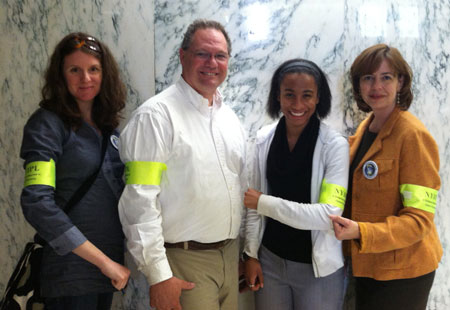
New York IPL folks sporting their armbands at Earth Day Lobby Day

More than 125 concerned citizens descended upon the New York State Capitol on April 25th, 2012, to call upon legislators to protect our fragile planet. New York Interfaith Power & Light was well represented, and proudly flaunted our presence with armbands that read “NYIPL – A Religious Response to Global Warming.”

After hearing from environmental leaders and politicians in the morning, activists gathered in groups to meet with the offices of more than 80 Senators and Assembly Members. We were encouraging them to support five bills:

  1. The Global Warming Pollution Cap – S. 2742 (Avella) and A.5346 (Sweeney) This bill would direct the Department of Environmental Conservation to establish an emissions limit for greenhouse gases from all sources, leading up to a 20% reduction by 2020, and until we reach a level of overall emissions in 2050 that would be 80% below 1990 levels.
    http://www.eany.org/images/2012BillMemos/31_globalwarmingcap.pdf
    Fate of the Bill: In response to our efforts, the Assembly version of this bill passed the assembly on 4/25/12, but ended the session in the Senate Environmental Conservation Committee.
  2. The Solar Jobs Act – A. 9149 (Englebright, et al.) This bill directs the Public Service Commission to develop an incentive program for solar photovoltaic (“PV”) systems, and establishes a goal to increase installed solar PV capacity by the year 2021.
    http://www.eany.org/images/2012BillMemos/30_solarjobsact_2.pdf
    Fate of the Bill: This bill ended the session awaiting hearing in the Assembly Ways and Means Committee.
  3. Hazardous Waste Loophole for Fracking Fluid Disposal – S.4616 (Avella, et al.) and A.7013 (Sweeney, et al.) This bill would require all waste that results from exploration, development, extraction or production of crude oil or natural gas, which includes drilling fluids and produced waters to be considered hazardous waste under the amendment of this bill.
    http://www.eany.org/images/2012BillMemos/1_defininghazardousfrackingwaste.pdf
    Fate of the Bill: A.7013 passed through the Assembly in February, but ended the session in the Senate Environmental Conservation Committee.
  4. EPF Enhancement Act – S.5403-A (Grisanti, et al.) and A.7137-A (Latimer, et al.) This bill would provide a net increase in resources allocated to the Environmental Protection Fund by phasing unclaimed bottle deposits from the General Fund into the EPF over four years.
    http://www.eany.org/images/2012BillMemos/20_epfenhancement_2.pdf
    Fate of the Bill: In May, A.07137 passed through the Assembly and ended the session in the Senate Finance Committee.
  5. The Child-Safe Products Act – A.3141-A (Sweeny , et al.) This act would establish a framework to identify and remove toxic chemicals from products that are designed to be used by children 12 and under. It will phase out children’s products made with priority chemicals starting January 1, 2016.
    http://www.eany.org/images/2012BillMemos/36_childsafeproductsact_3.pdf
    Fate of the Bill: On April 25 (the day of Earth Day Lobby Day), this bill passed through the Assembly but ended the session in the Senate Environmental Conservation Committee.

What you can do: Contact your Assembly Member and your Senator and tell them to make it a priority to pass the Global Warming Pollution Cap and the Solar Jobs Act (or similar measures) next year.

University United Methodist Church Connects the Dots

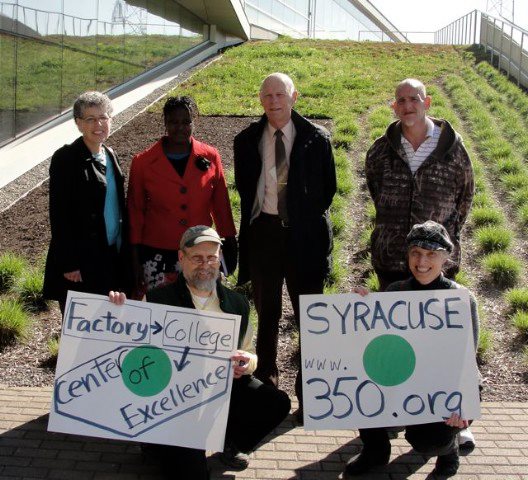
On May 5th,  “Climate Action Day,” members of University United Methodist Church in Syracuse gathered to Connect the Dots between severe weather and climate change at the Syracuse Center of Excellence, which is facilitating innovations in energy and environmental technology.  The building itself earned a LEED “platinum” rating (LEED is Leadership in Energy and Environmental Design).

Colorado Students Connect with NY Gardening Resources

greenhouse

We received this letter from an after school program in Colorado that students there are connecting with resources here to expand their efforts to “go green.”

My name is Sarah and I am an after-school counselor out in Colorado.  My students have been using your webpage, Eating Together, and brought to my attention how helpful it has been for their Gardening project!

As a thank you, one of my students, Danielle, suggested another resource:

The Greenhouse Gardening Guide

Could you add this to your page? I think it would be a great addition! I researched the article and it is very resourceful which is why I agreed to write to you when she asked me the other day.

We would like to thank you again for the wonderful resources and hope that you add our newly discovered resource to your page!

Thanks, Sarah, for all you’re doing to help your students reduce their carbon footprint. And thanks, Danielle, for sending this excellent resource our way!